
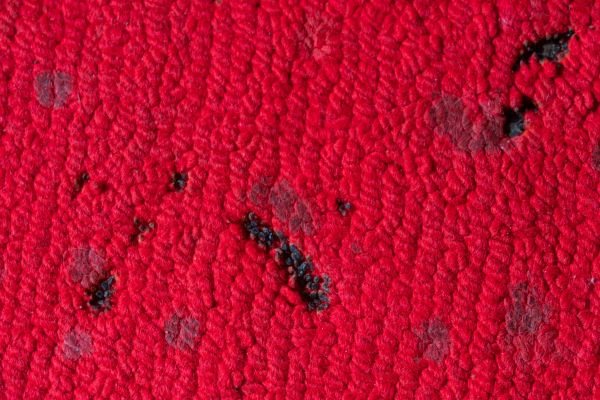
Why burns can't be cleaned out
Most wall-to-wall carpet in South Florida homes is nylon, polyester or another synthetic fiber. Those fibers melt rather than char. A burn fuses the tips of the tufts into hard, dark, glassy beads. Scrubbing only spreads the discoloration, and trimming the tips with scissors leaves a visible low spot. The only lasting fix is to replace the burned tufts.
Common burns we repair
Usually a crisp outline of the iron's soleplate, often in a bedroom or laundry area.
Narrow burns in bathrooms, closets and dressing areas.
Melted spots plus dripped wax, sometimes with scorching from the flame.
Small round burns, often several near a favorite chair or patio door.
Scattered small burns in front of fireplaces or space heaters.
Ring-shaped marks where a pot or pan was set down.
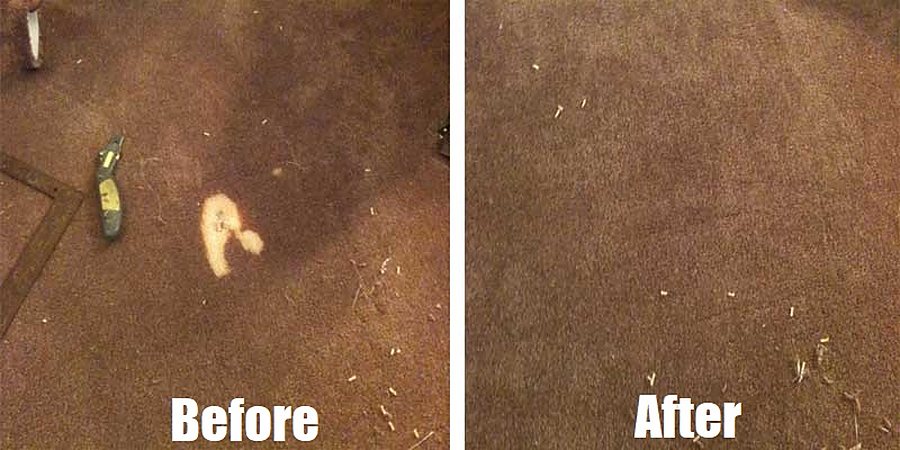
How we repair a carpet burn
- Check the extent of the burn
Burns are often wider underneath than they look on top. We check how far the melted fibers go so the repair removes all of it.
- Source a matching piece
A remnant or a hidden piece from a closet gives the best match in color, pile height and texture.
- Cut out the burn
We cut along the rows of the backing, just beyond the damage, so no hardened fibers are left at the edges.
- Install the replacement
The new piece goes in with the pile running the same way and is bonded with heat-activated seam tape.
- Blend it in
We groom the pile across the seam and check it from different angles before we leave.
Burn repair on different types of carpet
- Plush and Saxony: smooth, cut-pile carpet where pile direction matters most. A patch has to lean the same way to reflect light the same way.
- Frieze: twisted, shaggy fibers that hide seam lines well, which makes burn patches especially hard to spot.
- Berber and loop pile: loops have to be lined up row for row so the pattern carries straight across the repair.
- Patterned and cut-loop: the pattern is matched before cutting so the design continues through the patch.
Synthetic fibers like nylon and polyester melt into hard, dark beads instead of charring, which is why even a light-looking burn feels crunchy. Those melted fibers have to be removed completely or the edge of the repair shows.
Preventing the next burn
- Use an ironing board or a heat-proof mat, never a towel on the carpet.
- Set candles on a tray, away from curtains and where pets can't knock them over.
- Keep a heat-resistant mat for flat irons and curling irons in bathrooms and closets.
- Put a hearth rug in front of fireplaces and keep space heaters off carpet.
Carpet burn repair cost
Most single burns fall in the $75 to $150 range. Several burns in one room, or one very large burn, may be priced as a larger repair. Doing multiple spots during one visit costs less than separate trips.
Typical ranges for South Florida homes. Your exact price is confirmed at the free estimate, before any work starts. See the full price guide.
What to do right after a burn
- Make sure it's out and cool. Unplug irons and heaters and let the area cool completely.
- Don't cut the fibers. Trimming melted tips makes a dip that can make the final repair larger.
- Don't scrub. Scrubbing spreads soot and melted residue into the fibers around the burn.
- Lift off cooled wax gently. If wax is involved, let it harden and lift off what comes away easily. Leave the rest for us.
- Take a photo. Text a photo to 954-504-9629 and we can tell you what the repair involves before we come out.
Burns in rentals and homes for sale
Burn marks are one of the most common deductions at move-out, and one of the first things buyers notice on a walkthrough. A burn repair costs far less than replacing the room, and it's often done in under an hour. If the carpet also has ripples or a tired traffic lane, we can re-stretch and clean in the same visit so the whole room presents well.
Lifetime Labor Guarantee. If a burn repair we did lifts or comes apart because of our workmanship, we come back and fix it at no labor cost.